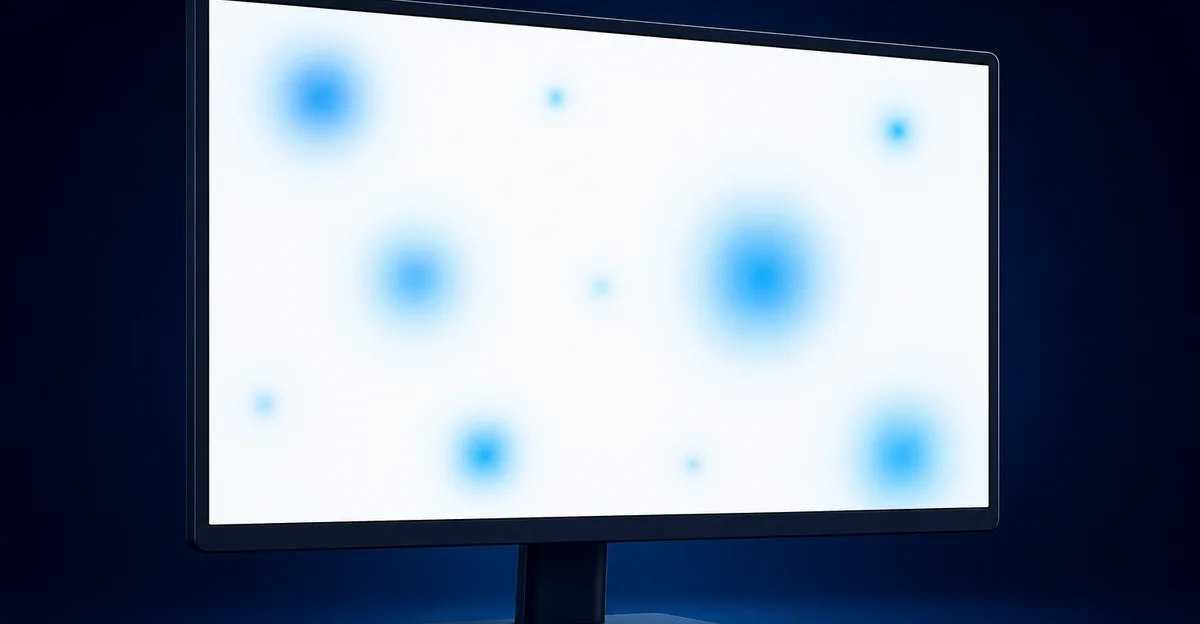
A blue spot on a phone screen — or a larger blue patch on a mobile screen — is a sub-pixel transistor failure, the same defect searched as blue spots on screen. This guide covers what causes it, how to confirm it on phone, tablet, laptop, and monitor, and whether the panel has to be replaced.
Blue Spots and Blue Dots on Screen: Causes & Fixes
Why Does a Blue Spot Appear on Your Screen
A blue spot on screen is a display defect where one or more pixels display a persistent blue-tinted discoloration instead of the correct color. Unlike dead pixels (which appear as tiny black dots) or stuck pixels (which glow a single bright color), blue spots show a muted blue hue that is visible across all screen content.
Blue spots occur when the thin-film transistor (TFT) controlling a pixel's sub-pixel structure malfunctions. Each pixel consists of three sub-pixels — red, green, and blue — that combine to create the full color spectrum. When the transistor driving the red or green sub-pixel fails, the blue sub-pixel dominates, creating a visible blue spot on the screen.
This defect is most commonly searched as blue spots on screen, blue spot on phone screen, blue spot on mobile screen, and blue patch on mobile screen — the same panel failure described with different words.
Blue Spot on Phone Screen vs Blue Patch on Mobile Screen
A blue spot on a phone screen is the same sub-pixel failure as blue spots on screen on a laptop or monitor: red or green stays off, blue stays on, so you see a pinprick or small blotch that does not move. People also search this as a blue spot on mobile screen — mobile and phone are the same query intent. The defect sits in the panel, not in the wallpaper, the case, or the OS.
A blue patch on a mobile screen is usually a larger version of the same failure, not a different diagnosis. A spot is a few pixels to a few millimetres. A patch is a clustered area — often 5–15 mm — where neighbouring transistors failed together after a drop, a tight case, or pressure from a pocket. If the patch has a soft edge and is brightest on white, it is still hardware. If the patch moves with an app, a screenshot, or a reboot, it is overlay or burn-in, not a blue patch in the panel.
How to tell them apart in one minute:
| What you see | Typical search | What it usually is |
|---|---|---|
| Tiny blue pinprick on a phone | blue spot on phone screen | Single sub-pixel stuck blue |
| Same pinprick, said as "mobile" | blue spot on mobile screen | Same defect, same panel |
| Soft blue blotch several mm wide | blue patch on mobile screen | Cluster of failed sub-pixels / pressure |
| Same blotch on laptop or monitor | blue spots on screen | TFT failure in an LCD, or OLED blue-channel wear |
On phones, drops and tight cases are the usual trigger. On tablets, sitting on the device. On laptops, closing the lid on debris. Confirm with a solid white field: if the spot or patch stays put, the panel is damaged. Software cannot remove it.
Sub-Pixel Transistor Failure Explained — The Real Cause
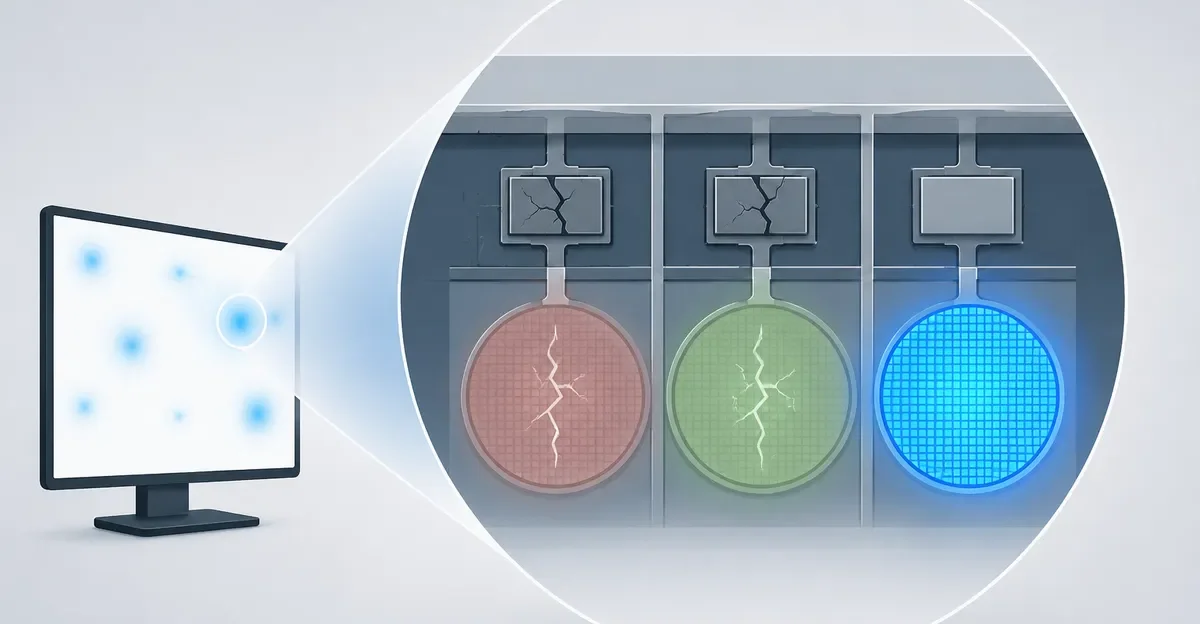
The root cause of most blue spots is thin-film transistor (TFT) failure within the LCD panel's pixel structure. To understand why, it helps to know how an LCD pixel works.
Each pixel on an LCD screen contains three sub-pixels — one red, one green, and one blue. Each sub-pixel has its own transistor that controls how much light it lets through. When you display a specific colour, the TFT for each sub-pixel adjusts to let the right amount of light through.
When the TFT for a red or green sub-pixel fails, that sub-pixel stops responding to colour signals. It either goes fully dark (like a dead pixel) or gets stuck at a partial level. Meanwhile, the blue sub-pixel continues working normally. The result is a pixel that outputs primarily blue light — what you see as a blue spot on display surfaces.
Why blue specifically? In most LCD panels, blue sub-pixels are physically larger than red and green ones, and they sit on top in the pixel architecture. This makes them less prone to failure. When a red or green transistor fails, the blue channel remains dominant — hence blue spots.
The three most common triggers for this failure:
- Physical impact — dropping a device or applying pressure to the screen
- Manufacturing defects — inherent weaknesses in the transistor that manifest over time
- Ageing — long-term heat and electrical stress slowly degrade transistor performance
Blue Spot vs Dead Pixel vs Bright Spot — Visual Comparison
It is easy to confuse blue spots with other display defects. Here is how to tell them apart at a glance:
| Blue Spot | Dead Pixel | Bright Spot | |
|---|---|---|---|
| Appearance | Blue-tinted area, muted colour | Permanently black dot | Glowing brighter than surroundings |
| Cause | Sub-pixel transistor failure | Complete pixel failure | Backlight or pressure damage |
| Visibility | Most visible on white/grey | Visible on all backgrounds | Most visible on dark backgrounds |
| On blue background | Blends in or disappears | Stays black | Stays bright/white |
| Fixability | Panel replacement only | Panel replacement only | Often fixable or livable |
The colour background test is the fastest way to distinguish them:
- Display a solid white background: all three defect types are visible
- Display a solid blue background: blue spots fade or disappear (they blend with the blue), dead pixels stay black, bright spots stay bright
- Display a solid red background: blue spots appear darker (red sub-pixels are off), dead pixels stay black
If you are not sure whether your issue is a blue spot, see our Dead Pixel guide and our LCD Bright Spots guide for detailed comparison.
iPhone vs Samsung vs iPad — Which Devices Get Blue Spots Most
Blue spots can appear on any device with an LCD screen, but certain device types have higher rates of occurrence:
Smartphones (iPhone, Samsung Galaxy, Pixel)
- Blue spots on phones are most commonly caused by physical impact from drops
- iPhones use LCD (on older models) and OLED (on newer models) — OLED blue spots are caused by organic compound degradation, a different mechanism from LCD transistor failure
- Samsung Galaxy phones use AMOLED displays where blue spots indicate localised OLED pixel degradation — blue OLED pixels age faster than red and green
- Phones are frequently dropped, making physical damage the leading cause
Tablets (iPad, Samsung Galaxy Tab, Lenovo)
- Blue spots on tablets are particularly common because of their large, exposed screens
- Sitting on a tablet, placing heavy objects on it, or dropping it creates pressure points that damage the display panel
- The larger surface area means that impact damage may spread more visibly than on a phone
- iPads use LCD panels — blue spots indicate LCD sub-pixel transistor failure from physical damage
Laptops (MacBook, Dell, HP, Lenovo)
- Blue spots on laptop screens are typically caused by closing the laptop with force (pressing the keyboard against the display)
- Carrying a laptop in a bag without protection subjects it to pressure and impact
- MacBook Pro and MacBook Air models have a known vulnerability — closing the lid with debris (like earbuds) on the keyboard causes pressure damage that manifests as blue or white spots
External Monitors
- External monitors are less prone to blue spots than portable devices because they are rarely moved or dropped
- When blue spots do appear on monitors, they are usually from manufacturing defects or long-term ageing
- Backlight issues can also create blue-tinted areas on older monitors
Real Case: After 18 Months, a MacBook Air Developed a Blue Spot
A MacBook Air owner reported a small blue spot appearing near the centre of the screen after 18 months of normal use — no drops or physical impacts. The spot was approximately 5mm in diameter and clearly visible against white backgrounds.
Diagnosis: The spot appeared spontaneously without any physical trauma, pointing to a manufacturing defect in the TFT layer of the LCD panel. MacBook Air panels are known to develop these defects over time due to thermal stress and the thin form factor.
What happened: The thin-film transistor controlling the red sub-pixels in a localised area gradually degraded until the red channel failed. The blue sub-pixels in the same area continued functioning normally, producing the blue tint.
Repair options presented:
- Apple Store diagnosis — The MacBook Air was still under AppleCare+, which covered full panel replacement at no cost
- Third-party repair — Estimated at $200–$350 for a new panel and installation
- Living with it — The spot was in the peripheral vision area and did not significantly affect daily use
Outcome: The owner chose option 1 and got the panel replaced under AppleCare+.
Key takeaway: If your laptop is still under warranty or extended coverage, always check before paying for repairs. Blue spots from manufacturing defects are often covered. Even if your device is out of warranty, a manufacturing defect blue spot is worth mentioning — some repair shops offer discounts on defects that are not user-caused.
Screen Test Tool — The Fastest Way to Confirm a Blue Spot
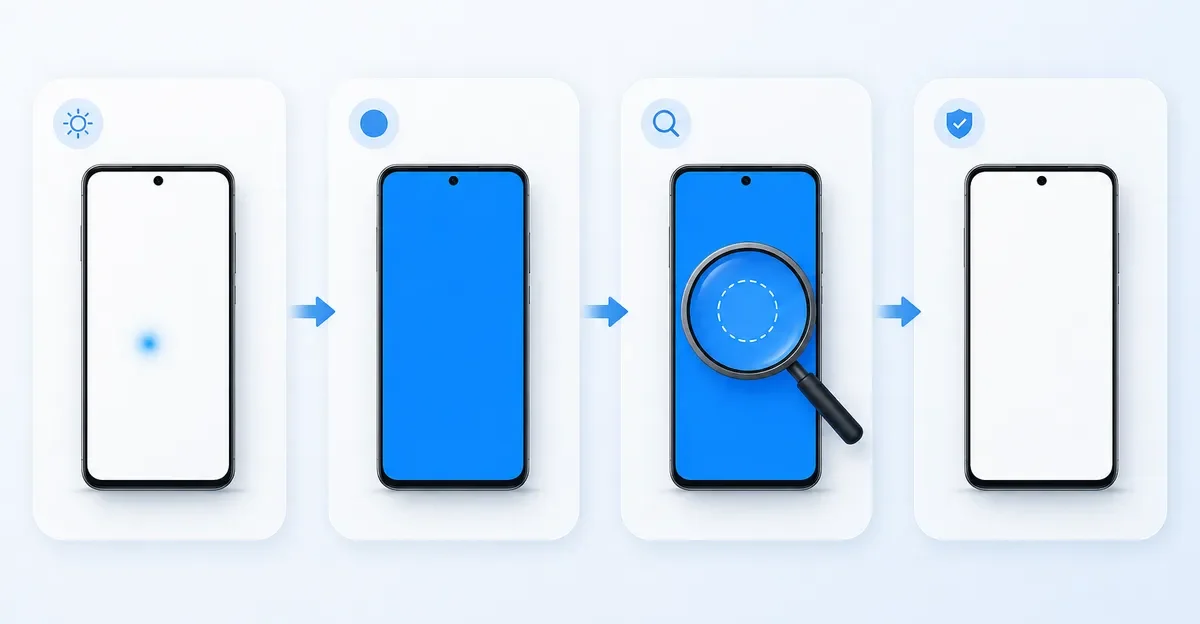
The screen test tool is the most effective way to confirm whether you have blue spots on screen and track whether they are spreading:
- Open the screen test tool on your device
- Display solid white — a blue spot will appear as a distinct blue-tinted area against the pure white, making it immediately visible
- Display solid grey backgrounds — this helps confirm the colour is truly blue and not a brightness variation
- Display solid red and green backgrounds — if the spot dims or disappears on non-blue backgrounds, it is strongly related to the blue sub-pixel channel
- Display solid blue — the spot should blend in or nearly disappear when the entire screen is blue
This diagnostic approach confirms it is a blue spot (sub-pixel issue) rather than a dead pixel (no light), a bright spot (backlight issue), or a white spot (pressure damage to LCD layer).
Regular testing helps you track whether a new blue spot is forming or an existing one is spreading. Place a sticky note over the spot's location and compare test results monthly.
Repair Costs by Device (Updated 2026)
Unfortunately, a true blue spot caused by sub-pixel transistor failure cannot be fixed with software. Here is what you can actually do:
What does not work:
- Pixel-fixing apps — these tools cycle through colours rapidly and target stuck pixels (where sub-pixels are stuck but the transistor still functions). A failed TFT transistor cannot be repaired this way.
- Screen massage — applying pressure may temporarily shift liquid crystals but will not fix transistor damage and risks making it worse.
- Software updates — blue spots are hardware failures, not software issues.
Panel replacement costs by device type:
| Device Type | Typical Repair Cost | Notes |
|---|---|---|
| External monitor (24–27") | $50–$150 | Panel replacement + labour |
| External monitor (32"+) | $150–$400 | Larger panels cost more |
| Laptop screen | $80–$300 | Varies widely by brand and model |
| Tablet (iPad, Galaxy Tab) | $100–$400 | Original parts are expensive |
| Smartphone (iPhone) | $80–$300 | Screen replacement varies by model |
| Smartphone (Samsung/Pixel) | $60–$250 | Aftermarket parts available |
Warranty coverage: If your device is under manufacturer warranty and the blue spot appeared without obvious physical damage, contact the manufacturer for a free screen replacement.
Living With a Blue Spot — Practical Workarounds
If the blue spot is small, located in a peripheral area, and panel replacement is not in your budget right now, here are practical ways to reduce its visual impact:
Software workarounds:
- Use dark mode — blue spots are far less visible against dark backgrounds
- Adjust your wallpaper — use dark or patterned wallpapers that mask the affected area
- Enable display colour filters — some operating systems let you shift the overall colour temperature to reduce blue visibility
- Zoom in on content — increasing text size and UI scaling moves more content away from the affected area
Physical workarounds:
- Position your device — angle the screen so the blue spot falls outside your natural reading area
- Use an external monitor — connect your laptop or tablet to an external display and position the problematic area off-screen
When to stop tolerating it and seek repair:
- The blue spot is in your primary viewing area and affects your productivity
- You notice the spot growing or new spots appearing
- The spot appeared after a drop and you suspect internal damage is progressing
- You are planning to sell the device — a blue spot significantly reduces resale value
Related Screen Issues
Blue spots can be confused with several other display problems. Learn more about related issues:
- Dead Pixel: Test and Fix Guide: Confusing blue spots with dead pixels? Learn the key differences
- Dead line of pixels: A streak of failed pixels, not a localised blue speck
- White spot on iPad screen: Pressure or backlight spots on a tablet
- LCD Bright Spots: Bright glowing areas are distinct from blue-tinted spots
- LCD Spot Damage: Physical damage to the display panel can manifest as various spot types
- White Spot LCD: White spots on LCD monitors have different causes and appearance
- Black Spot Diagnosis: Not sure what type of spot you have? Start here
- Mobile White Spots: White spots on phones may look similar to colour spots
- Black Line on Screen: A line defect is a different pattern from a localised spot
See also: Green Line on Screen — persistent green lines across your screen, a related display defect to blue spots caused by similar sub-pixel and panel circuit failures.
Also see: Red Screen: Persistent red tint on your display — cable, calibration, or hardware issue causing the blue colour channel to be lost.
See also: Orange Screen on Laptop: Persistent orange tint on your display — cable, calibration, or hardware issue
Conclusion
Blue spots on screen are display defects caused by sub-pixel transistor failure, physical damage, or manufacturing defects. They appear as persistent blue-tinted areas rather than fully dark (dead pixel) or fully bright (bright spot) areas. There is no software fix for blue spots — panel replacement is the only reliable solution. Use the screen test tool to confirm the issue and distinguish it from other screen problems. If the blue spot appeared after physical damage, check your warranty coverage and consider professional repair options.
Technical Deep Dive: Understanding LCD and OLED Blue Spot Differences
Blue spots appear differently depending on whether your device uses an LCD or OLED display. Understanding the technology helps you interpret the symptom more accurately.
LCD Panel Technology and Blue Spots
LCD (Liquid Crystal Display) panels work by controlling liquid crystal molecules between two polarised glass layers. Each sub-pixel has a transistor (TFT) that determines how much light from the backlight passes through.
On LCD screens, blue spots form through thin-film transistor (TFT) failure:
- The transistor controlling the red or green sub-pixel fails
- That sub-pixel stops responding to colour signals
- The blue sub-pixel in the same pixel continues working normally
- The result is a blue-tinted appearance in that area
LCD blue spots are caused by physical damage to the transistor layer. The damage is permanent and cannot be reversed — only panel replacement fixes it.
Where TFT damage occurs:
- Direct physical impact on the screen surface
- Pressure applied to the screen (sitting on a tablet, closing a laptop with force)
- Manufacturing defects in the transistor layer
- Ageing from long-term heat and electrical stress
OLED Panel Technology and Blue Spots
OLED (Organic Light-Emitting Diode) panels work differently — each sub-pixel generates its own light. There are no backlights and no liquid crystals. Each pixel is made of three tiny OLED emitters: red, green, and blue.
On OLED screens, blue spots form through a different mechanism:
- OLED blue pixels degrade faster than red and green pixels because blue organic compounds are less efficient
- When local blue pixels fail or degrade significantly, that area appears tinted yellow or orange
- Blue spots on OLED are actually areas where the blue channel has weakened, making red and green dominate
Why blue degrades fastest on OLED:
- Blue OLED organic compounds have lower luminous efficiency than red and green
- They require more current to produce the same brightness, accelerating wear
- Blue pixels are typically run at lower brightness to extend lifespan, but degradation still occurs
- Physical damage can cause immediate blue pixel failure in a localized area
How to Tell If Your Device Is LCD or OLED
This matters for understanding your blue spot:
- iPhone: Models before iPhone X used LCD. iPhone X and later use OLED (except iPhone XR and iPhone 11 which are LCD)
- Samsung Galaxy: Most Samsung phones from Galaxy S8 onward use AMOLED/OLED
- Google Pixel: Pixel 2 and later use OLED (original Pixel used LCD)
- iPad: All iPads currently use LCD
- MacBook: All MacBooks use LCD
- Most external monitors: Use LCD
Quick test: Display a pure white screen in a dark room and look at the screen from an angle. If you see slight colour shifting at the edges, it is likely LCD. If the screen looks uniform, it could be either technology.
Real Case Studies: Blue Spots Across Device Types
Case 1: iPad Pro After Two Years of Normal Use
An iPad Pro owner noticed a blue spot appearing near the bottom-right corner after two years of careful use with a protective case and screen protector.
Diagnosis: The spot appeared without any physical impact or water damage. Given the iPad Pro's age and the localized nature of the spot, this pointed to a manufacturing defect in the TFT layer that had gradually worsened.
What happened: The thin-film transistor controlling the red sub-pixels in a small cluster had degraded over time due to thermal stress. The iPad Pro generates significant heat during charging and heavy use, and the continuous thermal cycling gradually stressed the transistor connections.
Outcome: The owner had AppleCare+ and got the display replaced at no additional cost. Without coverage, a replacement would have cost approximately $450.
Lesson: Even with careful handling, manufacturing defects can manifest as blue spots over time. Register your devices and check warranty status before paying for repairs.
Case 2: Samsung Galaxy S20 Drop Resulted in Multiple Blue Spots
A Samsung Galaxy S20 owner dropped their phone from about three feet onto a hardwood floor. The screen showed no visible cracks, but over the following weeks, two blue spots appeared near the impact area.
Diagnosis: The impact had damaged the transistor layer even though the glass was intact. Internal damage from drops often manifests as spreading display defects.
What happened: Physical impact can crack the internal layers of a display without cracking the outer glass. The force transmitted through the screen damaged the TFT circuits in a localized area. The spots spread because internal pressure from the damaged area affected neighbouring pixels.
Outcome: The owner had the screen replaced at a third-party repair shop for $180 (Samsung quoted $280). The repair was done using an aftermarket display panel.
Lesson: Always check for internal damage after dropping a device, even if the screen looks fine. Blue spots appearing after a drop indicate physical damage to the display layers.
Case 3: External Monitor With Age-Related Blue Spot
A 4-year-old Dell 27" monitor developed a blue spot near the centre of the screen. The monitor had been used daily for work.
Diagnosis: Age-related degradation of the TFT layer. After four years of continuous use, the transistors in a localized area had failed.
What happened: Long-term electrical stress and heat gradually degraded the transistor performance. The red sub-pixel transistor in a small cluster eventually failed completely, leaving only the blue sub-pixel functioning.
Repair options considered:
- Monitor repair shop: $120–$180 for panel replacement
- New monitor: $150–$200 for a comparable replacement
- Living with it: the spot was in peripheral vision
Outcome: The owner chose to buy a new monitor. The repair cost approached half the price of a new monitor, and the old monitor had other age-related issues.
Lesson: When repair costs approach 50% of replacement value, especially on older devices, buying a replacement is often more economical.
Prevention: Protecting Your Devices From Blue Spots
While not all blue spots are preventable, understanding risk factors helps you reduce the likelihood of this defect.
Physical Protection
Screen protectors:
- Tempered glass screen protectors provide the best protection against impact damage
- They absorb impact energy that would otherwise transmit to the display layers
- A $20–$40 tempered glass protector can save you hundreds in screen repairs
- Apply screen protectors carefully to avoid trapping air bubbles
Cases and bags:
- Tablets and phones should always be in a protective case
- Never carry a tablet in a bag without a dedicated pocket
- Laptops should be in a padded sleeve when not in use
- Avoid placing heavy objects on top of devices
Laptop-specific prevention:
- Always check the keyboard before closing the lid — remove pens, earbuds, and debris
- Do not close the lid with force
- Use a keyboard cover when working in environments with debris
- Avoid carrying a laptop by the screen
Environmental Factors
Temperature management:
- Avoid using devices in extreme heat (direct sunlight, hot cars)
- Give devices time to cool down before using them after they've been in heat
- Monitor charging temperatures — remove cases during intensive charging
Humidity and liquid:
- Keep devices away from liquids
- High humidity can corrode internal connections over time
- Use silica gel packets in device storage areas
Handling Practices
Daily habits:
- Set devices down gently rather than dropping them onto surfaces
- Avoid placing drinks near devices
- Do not use devices while walking or moving
- Keep devices away from edges of desks and tables
Transportation:
- Always use a dedicated device bag or pocket
- Do not stack heavy items on top of devices
- Secure devices during travel to prevent impact from movement
When Blue Spots Indicate Other Problems
Blue spots can sometimes be a warning sign of broader issues with your device.
Spreading Blue Spots After Physical Damage
If blue spots appear after a drop and continue spreading, the internal damage may be progressing. This can indicate:
- Cracked internal layers are pressing on display circuits
- Chemical leakage from damaged components
- Thermal damage spreading from the impact point
Action: Stop using the device and seek professional diagnosis. Continuing to use a device with spreading internal damage can cause complete display failure.
Blue Spots Combined With Colour Distortion
If blue spots are accompanied by colour distortion in surrounding areas, the issue may extend beyond isolated pixel failures:
- Cable connection issues can cause colour problems alongside pixel failures
- Driver or software issues can interact with hardware failures
- Complex failures require professional diagnosis
Sudden Appearance Without Cause
A blue spot appearing suddenly, without any physical impact, can indicate:
- Manufacturing defect manifesting over time
- Electrical failure from power surges
- Thermal stress from overheating
Action: Document when the spot first appeared and check warranty coverage. Manufacturing defects may be covered even after the standard warranty expires if they are known issues.