Best Sensors for Greenhouse Monitoring in 2026
If you searched for the best sensors for greenhouse monitoring, you are usually not shopping for a full climate computer. You want trustworthy air temperature and relative humidity at the crop — with phone alerts, history you can export, and hardware that survives a humid house. That is the job of a modern Bluetooth thermo-hygrometer, not a decorative room gadget stuck on the door frame.
This guide ranks four Amazon sensors we track for hobby and small commercial greenhouses: the budget TempPro TempAir, the multi-zone Govee H5075 3-Pack, the portable Govee Mini 3-Pack, and the water-resistant SensorPush HT.w with dew point and VPD in the app. You will leave knowing what accuracy and placement actually matter, when Bluetooth is enough, and which pick matches your budget and humidity risk.
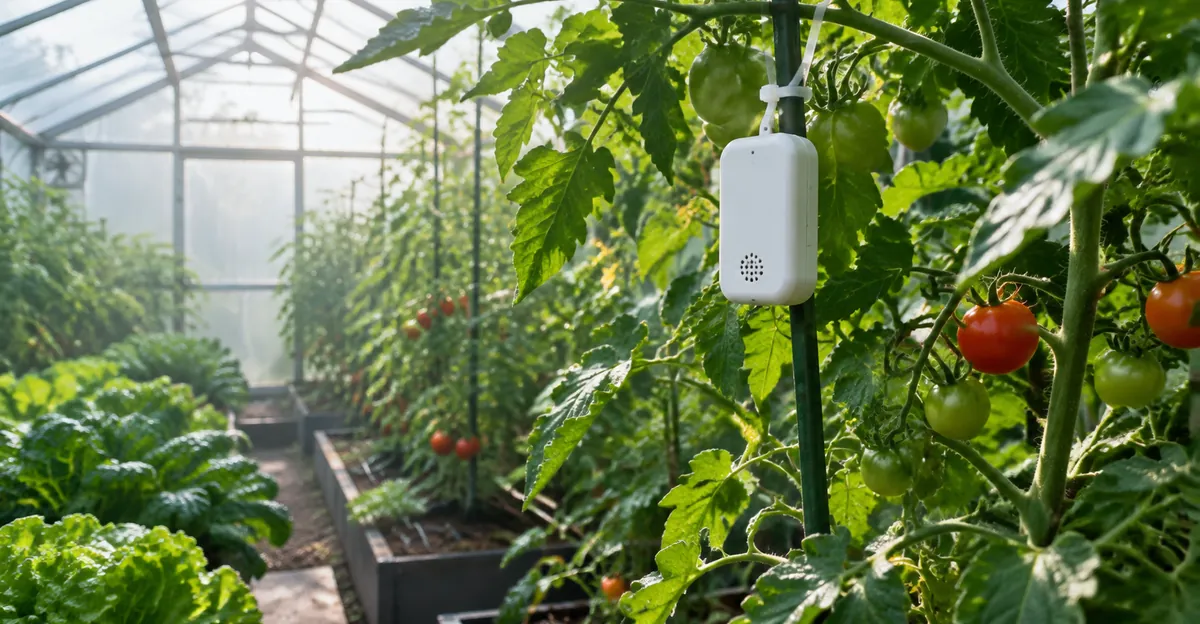
Quick Picks: Best Sensors for Greenhouse Monitoring
| Pick | Product | Best for | Price (approx.) |
|---|---|---|---|
| Overall budget | TempPro TempAir | First sensor, local display + app | $14.99 |
| Multi-zone value | Govee H5075 3-Pack | Canopy + door + bench coverage | $34.99 |
| Portable / incubator | Govee Mini 3-Pack | Moving sensors between spaces | $35.99 |
| VPD + weatherproof | SensorPush HT.w | Humid edges, dew point & VPD | $69.99 |
These four cover the search intent behind best sensors for greenhouse monitoring without forcing you into industrial PLC transmitters or subscription-heavy farm platforms. If your house is under a few thousand square feet and your decisions are “vent now / heat now / fog less,” start here.
What to Look for in a Greenhouse Temperature Humidity Sensor
A greenhouse temperature humidity sensor is only useful if it measures the air the plants live in. Extension-style deployment guidance is consistent across niche grow sites: put the primary probe at canopy height in a representative growing zone, shield it from direct sun, and keep it away from heaters, vents, fans, and irrigation spray. Aisle-only sensors under-read humidity pockets inside dense foliage and over-read heater blasts near equipment.
Accuracy targets that matter for growers
Consumer listings rarely match research-grade probes. For practical greenhouse control, look for capacitive humidity sensing in the roughly ±2–3% RH class and temperature near ±0.3–0.5°C (±0.5–0.9°F) when those figures are published. EcoSentec-style buying notes often cite about ±0.5°C as a workable floor for keeping setpoints honest. Capacitive RH sensors are preferred over cheap resistive types because they recover better from condensation and stay stable across the 0–100% RH swings common after fogging or night cooling.
You do not need a NIST-traceable lab certificate for a backyard tomato house. You do need sensors that agree with each other when placed side by side for a day, and a habit of checking a second meter after a storm season. Drift happens; treat annual reference checks as normal ownership, not failure.
Radiation, sun load, and false heat
Direct sun on a black plastic body can add false degrees even when air temperature is fine. Professional greenhouse probes use white radiation shields or aspirated housings for that reason. Consumer Bluetooth tags usually lack those shields, so placement discipline replaces hardware: hang the sensor in shade under a leaf canopy, behind a white cup shield you improvise, or on the north side of a post. Ageon’s commercial guidance also stresses raising the mount as the canopy grows so the white shield stays at the active apex — the same height logic applies to a Govee or TempPro tag on a zip-tie.
How many points to instrument
Cultivating Flora’s hobby sizing rule of thumb is useful: up to about 200 sq ft, one well-placed canopy sensor can represent the house; medium structures often want a sensor per 500–1,000 sq ft plus end checks on long runs; propagation benches deserve their own point because seedling RH risk differs from mature fruiting crops. That is why multipacks beat a single “Amazon’s Choice” indoor unit for real greenhouse work — gradients from pad to exhaust are normal during ventilation.
Logging interval and history
Log often enough to catch venting and heating events. Niche guides commonly suggest 5–15 minute intervals and at least 30 days of retained history; the four products below advertise multi-year app storage or export, which is more than enough for seasonal pattern hunting. Alarms for prolonged RH above roughly 85% and crop-specific temperature bands turn a logger into a disease early-warning tool instead of a novelty graph.
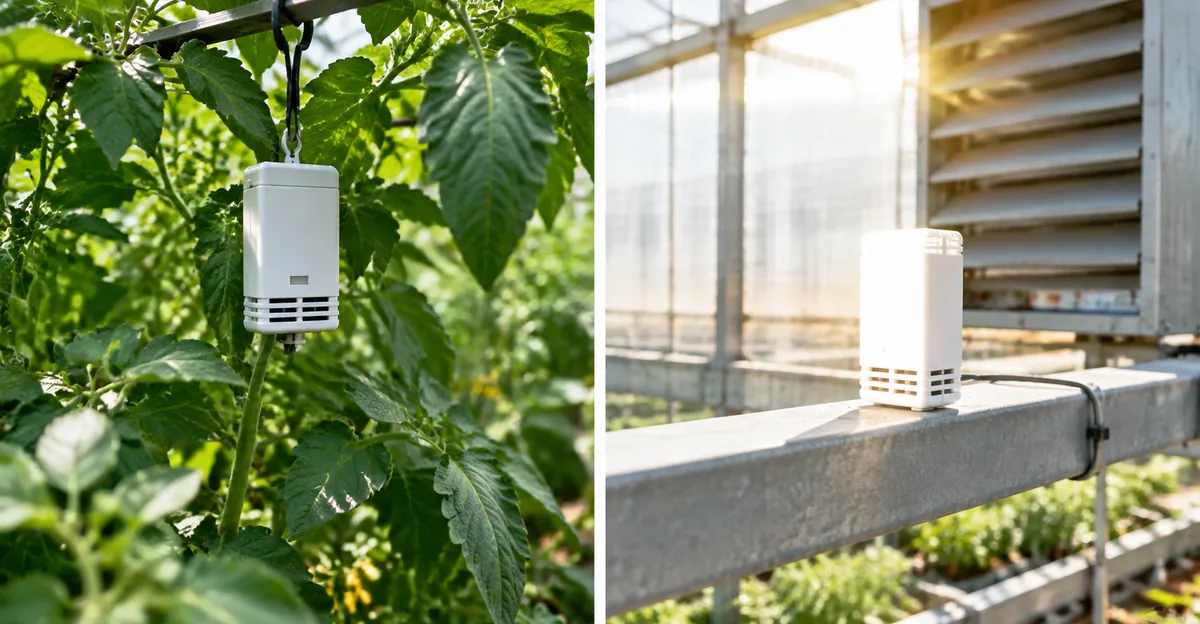
Best Bluetooth Hygrometer for Greenhouse — Our Picks Compared
Searching for the best bluetooth hygrometer for greenhouse use usually means you want phone graphs without pulling cable through glazing. Bluetooth Low Energy is the default first step for small houses: cheap sensors, multi-year batteries on many models, and pairing measured in minutes. Real-world agricultural range often lands closer to 30–100 feet through structure and foliage than the open-air “260 ft” marketing claims — openagriculturetechnology-style notes flag polycarbonate as fairly radio-friendly and metal framing plus dense canopy as the attenuators.
Side-by-side comparison
| Feature | TempPro TempAir | Govee H5075 3-Pack | Govee Mini 3-Pack | SensorPush HT.w |
|---|---|---|---|---|
| Approx. price | $14.99 | $34.99 | $35.99 | $69.99 |
| Rating | 4.3 (1,734) | 4.5 (48,355) | 4.3 (13,287) | 4.6 (1,666) |
| Units in box | 1 | 3 | 3 | 1 |
| Bluetooth range claim | ~260 ft | App remote (Bluetooth) | ~262 ft | Bluetooth; G1 Gateway optional |
| Local display | Large backlit | App-first | App-first mini | App-first |
| VPD / dew point | Check app features | App T/RH focus | App T/RH focus | Dew point, VPD, heat index |
| Moisture resistance | Indoor/greenhouse use | Indoor-oriented | Portable indoor/greenhouse | Water resistant |
| Data export | Up to 2 years | Up to 2 years | Up to 2 years | Unlimited in-app; Gateway path |
TempPro TempAir — budget overall pick
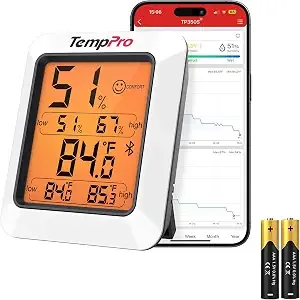
TempPro’s TempAir listing is aimed squarely at greenhouse buyers: Bluetooth thermo-hygrometer marketing, roughly 260 ft range claims, a large backlit display you can read without unlocking a phone, and two-year data export. At about $14.99 with solid recent purchase volume, it is the cheapest way to stop guessing whether the house cooked seedlings at noon. Start here if you only need one canopy point and you like glancing at a physical screen while watering.
Limitations are honest: one sensor does not map inlet-to-exhaust gradients, and the ecosystem lacks SensorPush’s gateway-first remote story. Buy a second unit later if you expand benches.
Govee H5075 3-Pack — multi-zone workhorse
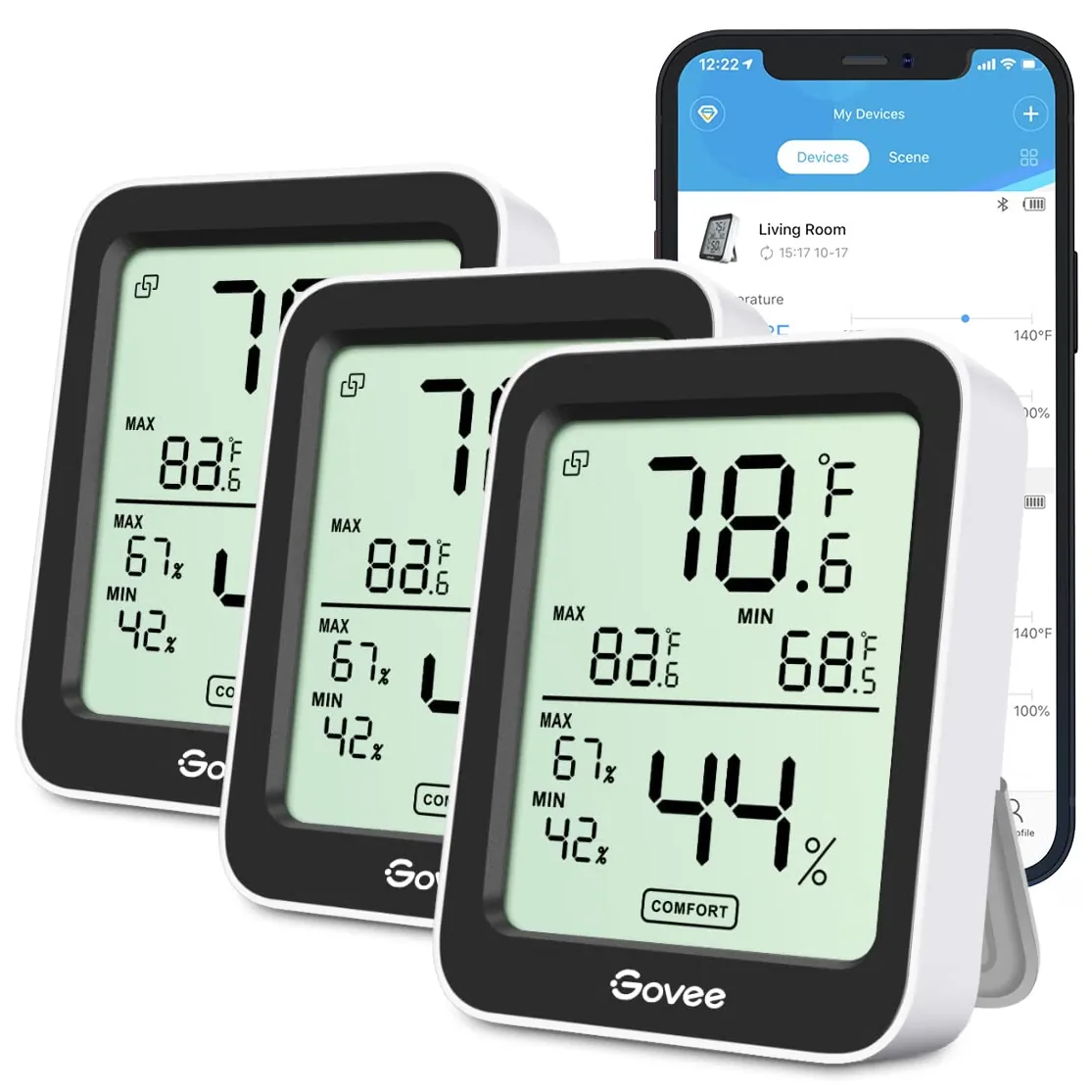
The Govee Indoor Hygrometer Thermometer 3-Pack H5075 is the volume champion — tens of thousands of reviews, Bluetooth app control, smart alerts, and two-year storage/export. For greenhouse monitoring, the multipack is the product: put one at canopy center, one near the door or exhaust, and one on a propagation tray. That single purchase answers “is the door microclimate lying to me?” better than one premium probe in the wrong place.
It is indoor-oriented hardware. Keep units out of hose spray and standing condensation. If your house regularly hits near-100% RH overnight, plan to wipe housings and watch battery life, or graduate wet corners to the HT.w.
Govee Mini 3-Pack — portable greenhouse and incubator
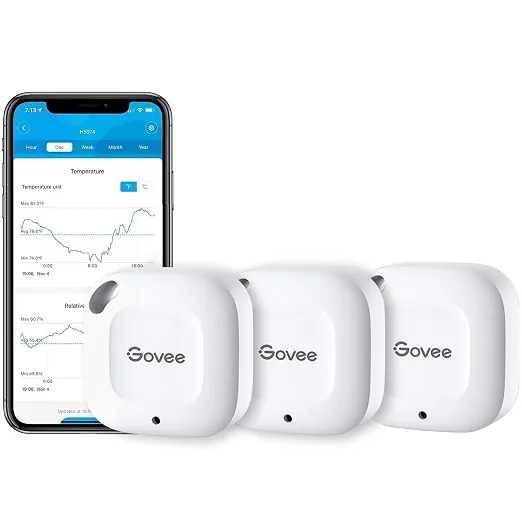
Govee’s Mini Bluetooth 3-Pack is marketed for greenhouse and incubator work with alerts, a claimed ~262 ft range, precision sensing, and two-year export. The mini footprint fits shelves, seed trays, and incubators where a display brick is awkward. If you rotate sensors between a backyard greenhouse, a grow tent, and a hatcher, this pack is more flexible than one fixed display unit.
Choose H5075 when you want the most proven Govee review stack for static multi-zone coverage; choose Mini when form factor and portability matter more than brand familiarity.
SensorPush HT.w — serious humidity and VPD upgrade
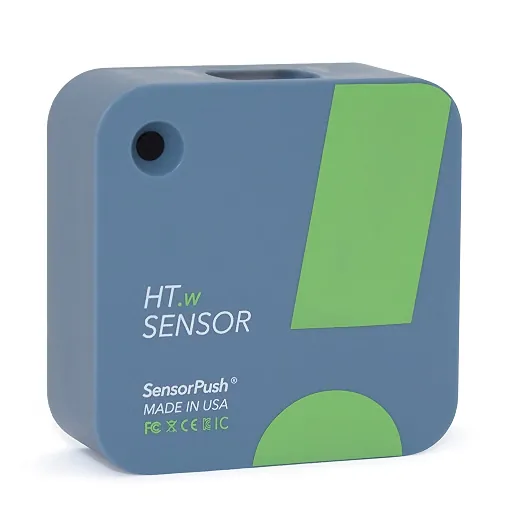
The HT.w Temperature & Humidity Sensor from the SensorPush store is the upgrade path: water-resistant construction, Bluetooth sensing that reports dew point, VPD, and heat index in-app, unlimited in-app data, USA-made positioning, and compatibility with the G1 Gateway for away-from-home monitoring. At about $69.99 it costs more than an entire Govee multipack, but you are buying moisture tolerance and plant-relevant derived metrics, not just another RH percentage.
If mildew, Botrytis risk, or fogging nights are your real enemy, this is the Bluetooth hygrometer that behaves like a grower’s instrument instead of a bedroom gadget.
VPD and Dew Point: Why RH% Alone Is Not Enough
A VPD sensor for greenhouse work is usually a temperature/humidity sensor whose firmware or app calculates vapor pressure deficit — not a mysterious third probe. VPD is the gap between how much water vapor the air could hold at a given temperature and how much it actually holds. Grower education from Sigrow and similar horticulture sources stresses the same point: relative humidity swings with temperature, while VPD tracks the drying power that drives transpiration. Low VPD (air nearly saturated) stalls evaporation and invites condensation films where fungi start; high VPD (thirsty air) can stress stomata and force plants to shut down photosynthesis to conserve water.
Dew point as the condensation alarm
Dew point is the temperature where moisture leaves the air as liquid. If a leaf or fruit surface cools below dew point — common late at night on clear nights — free water appears even when daytime RH looked “fine.” Sigrow’s dew-point framing is practical: RH can move from 90% before sunrise to 70% at noon while dew point barely changes. Watching dew point (or leaf-vs-air gaps on advanced systems) catches disease risk that a single afternoon RH glance misses.
What consumer sensors can and cannot do
SensorPush HT.w already exposes dew point, VPD, and heat index alongside temperature and humidity — that is enough for most hobby growers to steer vents, heat, and fogging. True leaf-level VPD needs infrared leaf temperature (commercial products like Sigrow Pixel), which sits above this article’s Amazon Bluetooth shortlist. Do not wait for leaf IR before buying any sensor; start with accurate air T/RH at canopy height, enable VPD if the app offers it, then upgrade only if commercial microclimate control justifies it.
Practical alarm bands
Niche grower checklists often flag prolonged RH above ~85% as a disease risk window and recommend logging both light and dark periods. Pair that with crop-stage VPD charts from your seed supplier or extension PDF rather than chasing one universal kPa number for every plant. The sensor’s job is continuous truth; your job is matching thresholds to tomatoes versus orchids versus seedlings.
Wireless Greenhouse Monitoring — Range, Alerts, and Data Export
Wireless greenhouse monitoring for this buyer class means Bluetooth sensors talking to a phone app, optionally bridged through a Wi-Fi gateway to the cloud. Ruuvi’s greenhouse docs spell out the pattern cleanly: phone-only Bluetooth for on-site graphs and alerts; add a gateway when you need readings from anywhere with internet. SensorPush’s G1 Gateway follows the same architecture for HT.w owners who leave for work while seedlings bake.
Range reality check
Marketing distances of 260–394 ft assume open air. Greenhouse metal benches, wet foliage, and insulated walls cut that down. Practical BLE deployments for small agricultural sites often land in the 30–100 ft band unless you add a proxy or gateway with a better antenna. If the house sits 200 feet from the kitchen, plan a gateway or accept that alerts only fire when you walk within range — still valuable for after-work checks, less useful for noon heat spikes while you are downtown.
Alerts that change grower behavior
Useful alerts are threshold-based and actionable: high temperature during heat waves, low temperature before frost nights, RH stuck high after irrigation, or VPD out of band for hours. Push notifications on reconnect are better than nothing; gateway-backed SMS/email/cloud push is better when crop value is high. Set wider deadbands first so you are not silencing a screaming phone every time a door opens.
Data export for seasonal learning
All four shortlisted products advertise long history and export (two-year windows on Govee/TempPro; unlimited in-app on SensorPush). Export CSV after a heat wave or a Botrytis scare so you can see whether night RH or afternoon peaks were the culprit. Thirty days of graphs already beats memory; multi-year history lets you compare springs.
Bluetooth vs Wi-Fi vs LoRa (keep it simple)
Stay on Bluetooth multipacks until range or remote alerting fails. Wi-Fi sensors need power and 2.4 GHz coverage inside wet structures. LoRa/gateway farm systems shine for multi-bay commercial sites — outside the price and complexity of this guide’s Amazon picks. Escalation path inside this list is clear: TempPro or Govee for local Bluetooth → SensorPush HT.w + G1 when you need moisture rating and remote cloud.
Waterproof and Outdoor-Rated Sensors for Humid Greenhouses
A waterproof greenhouse humidity sensor becomes important the moment condensation pools, fogging systems mist the air, or you hang a probe near an open vent that sees rain splash. Capacitive sensors often recover from brief condensation, but housings, battery doors, and USB ports on indoor-rated packs are the weak points.
Indoor packs: use them, but place carefully
Govee H5075 and Mini units, plus TempPro TempAir, are appropriate for many hobby greenhouses when mounted under eaves of foliage, away from misters, and wiped after extreme nights. Treat them as splash-aware, not hose-proof. If a unit dies after a season of 99% RH nights, that is a known risk of indoor SKUs in agricultural humidity — budget multipacks make replacement cheap.
Water-resistant upgrade: SensorPush HT.w
HT.w’s water-resistant design is the shortlist answer for wet edges, outdoor-adjacent cold frames, and houses that regularly fog. Pair it with canopy placement rules still — waterproofing does not fix sun-load error or aisle bias. For fully outdoor weather stations or wash-down industrial zones, step up to IP65/IP66 agricultural nodes (Ruuvi, UbiBot, industrial transmitters); those sit beside, not instead of, the consumer Bluetooth shopping trip this article covers.
Battery and chemistry in heat
Greenhouses can exceed the comfort range of coin cells on summer afternoons. Prefer mounts with airflow, avoid black metal surfaces that cook the battery, and keep a spare cell on the workbench. High heat plus high humidity is harder on seals than either factor alone.
How to Deploy Your Sensors in One Afternoon
- Pick zones: canopy center, optional door/exhaust, optional propagation bench.
- Mount at canopy height with zip ties or clips; leave slack to raise later.
- Shade the body from direct sun; improvise a white cup shield if needed.
- Pair the app, set 5–15 minute logging if configurable, and export a test CSV.
- Set alerts for high temp, low temp, and high RH; widen thresholds after a week of noise.
- Calibrate sanity: run two sensors side by side for 24 hours; note offsets before trusting absolute numbers.
- Review weekly for the first month; adjust vents and watering from data, not vibes.
This deployment sequence turns any of the four picks into a real monitoring system instead of an unopened Amazon box.
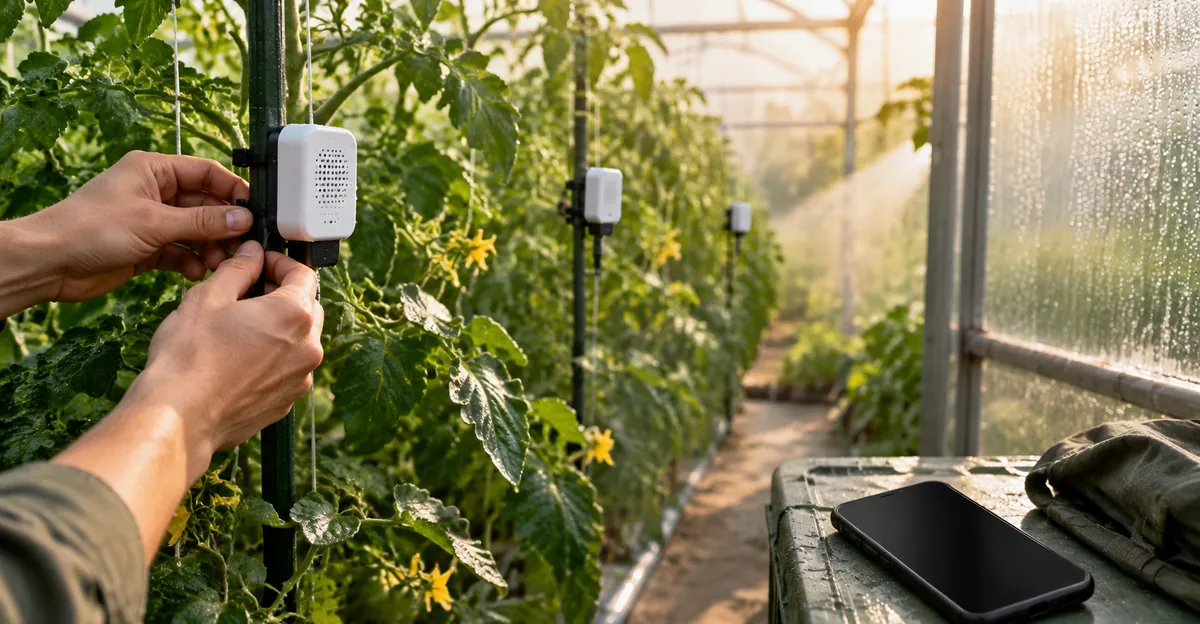
Which Sensor Should You Buy?
- Buy TempPro TempAir if you want the lowest price, a readable backlit display, and one solid canopy point to learn wireless greenhouse monitoring.
- Buy Govee H5075 3-Pack if you need three zones immediately and trust a high-volume Bluetooth app ecosystem.
- Buy Govee Mini 3-Pack if sensors must move between greenhouse benches, incubators, and tents.
- Buy SensorPush HT.w if water resistance, dew point, and VPD matter, or if you plan a G1 Gateway for true remote alerts.
Many growers correctly buy a Govee multipack for coverage and one HT.w for the wettest, highest-value zone. That hybrid still costs less than a single commercial climate node with annual software fees.
FAQ
Where should I place a greenhouse temperature humidity sensor?
Place the main sensor at canopy height in a representative crop zone, not only in the walkway. Keep it clear of sun, heaters, vents, and spray. Raise it as plants grow. Add inlet/exhaust sensors on long houses to see gradients.
Is Bluetooth enough, or do I need a gateway?
Bluetooth covers walk-up checks and nearby phone alerts. Add a gateway when the house is out of daily phone range or you need cloud alerts at work. SensorPush’s G1 path is the upgrade inside this shortlist.
How many sensors do I need?
Hobby houses under ~200 sq ft often start with one canopy sensor. Medium houses use multiple points; multipacks make that cheap. Always give seedling benches their own reading when damping-off risk is high.
Can indoor hygrometers survive greenhouse humidity?
Often yes with careful placement. Prefer water-resistant HT.w for chronically wet or splash-exposed spots. Expect shorter life if indoor packs sit in standing condensation.
Do I need a dedicated VPD sensor?
You need accurate T/RH and an app that calculates VPD and dew point. HT.w covers that for most growers. Leaf-IR systems are optional commercial upgrades.
When do I add soil, CO₂, or light sensors?
After canopy T/RH is online. Soil moisture for irrigation mistakes, CO₂ only if enriching, PAR when lighting or shade is an active control. Do not delay the first thermo-hygrometer.
Related guides on Screen Issues
Continue with other buyer guides on this site: best laptop for coding and programming if you are building a desk for farm-office work, BAZIC 12-digit dual power desktop calculator for a simple bench calculator, best JBL studio monitors for workspace audio, and how to fix a broken screen protector for phone glass. To check any display you use while reading sensor graphs, run the free screen test.
Bottom line
The best sensors for greenhouse monitoring for most Amazon shoppers are Bluetooth temperature/humidity loggers placed at canopy height with alerts and export enabled. Start with TempPro TempAir for one cheap truthful point, step to a Govee 3-Pack when zones matter, choose Govee Mini when portability wins, and upgrade wet or VPD-critical spots to SensorPush HT.w — optionally with a gateway when wireless greenhouse monitoring must follow you off-site. Measure the crop air first; expand to soil, CO₂, and PAR only after that foundation is logging every day.