Black Spots on OLED Screen: Dead Pixels, Burn-In, or Damage?
Black spots on an OLED screen mean some pixels are no longer producing light—or something on the glass is fooling you into thinking they are. Unlike LCD black spots, which can involve a backlight or diffuser, OLED has no separate backlight: each subpixel is its own emitter. That changes diagnosis, what “fixes” can do, and when replacement is the only honest option. This guide walks through dead pixels, impact damage, the burn-in mix-up, device-specific patterns for TVs, phones, and monitors, and a warranty-ready evidence path.
What an OLED Screen Black Spot Actually Is
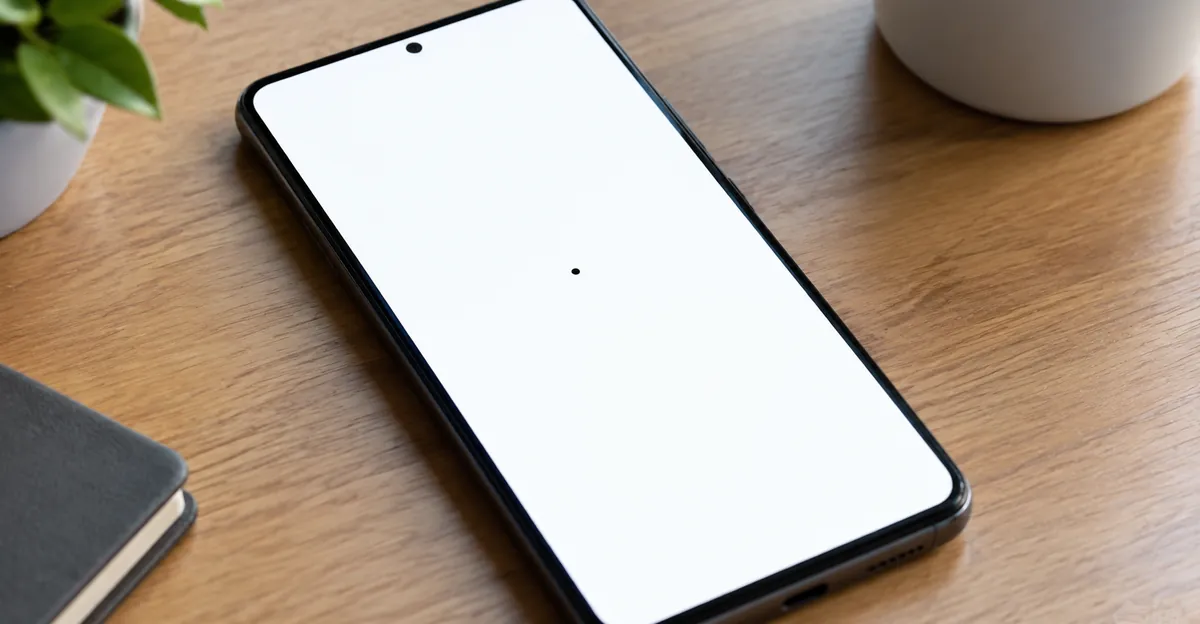
An OLED screen black spot is a fixed dark defect that stays in the same place while content changes. On healthy OLED, black is simply “pixel off.” A black spot is the opposite problem: the pixel (or a cluster of pixels) cannot turn on when the image needs light there.
Typical traits:
- Appearance: Pure black or near-black against white and bright colors
- Size: From a single subpixel-scale speck to an irregular blotch after impact
- Stability: Does not drift with the image; may be invisible on black content
- Not burn-in: Burn-in is uneven wear that usually looks like a faint logo or bar, not a pin-point dead emitter
OLED emitters fail differently from LCD shutters. Official and niche guides converge on the same mechanism: if the organic emitter or its drive circuit fails open, that location stays dark on every test color. Partial failures more often show as stuck bright subpixels (always red, green, or blue) than as true black dots—but when a full pixel dies, it looks like the classic dead-pixel black spot on LCD as well.
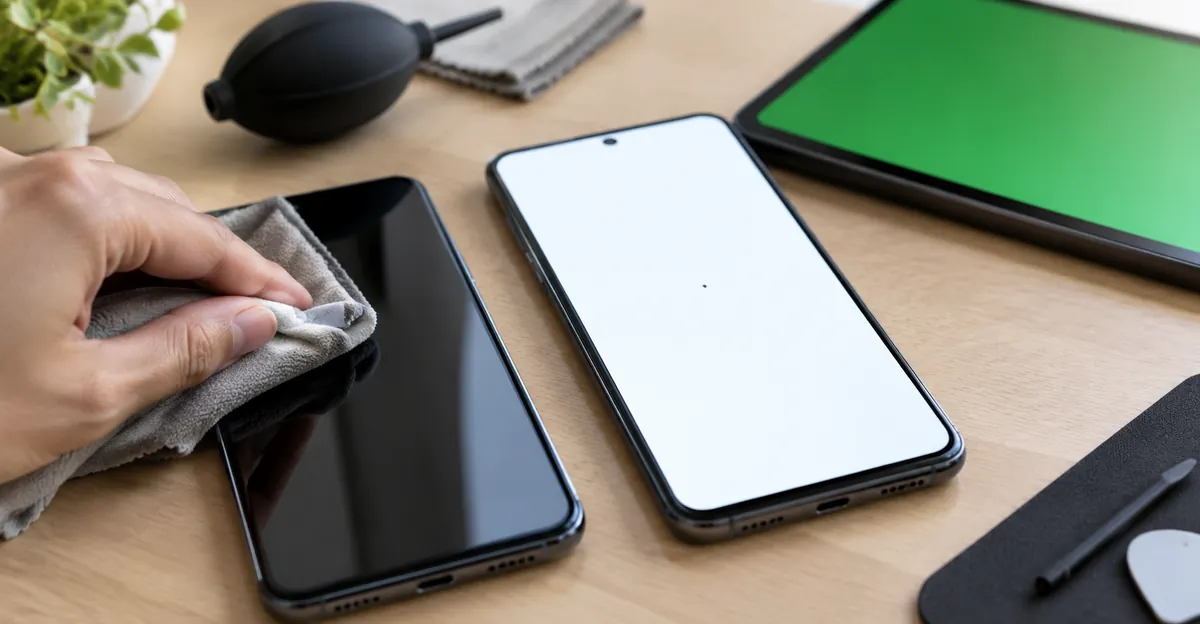
Before you assume hardware failure, wipe the panel with a dry microfiber cloth. Dust, fibers, and fingerprints sit on the cover glass and can look identical to a dead pixel until they move or vanish. Testing sources such as oledtest.org and dead-pixel-check.com both put cleaning first for exactly this reason.
Also confirm the mark exists across sources. LG’s support guidance for “lines or spots” on OLED TVs starts with HDMI and set-top box checks: a bent cable or a bad stream can paint spots that disappear when you open the TV’s own menu or picture test. If the spot exists only inside one app or input, you do not have an OLED black spot—you have a source artifact.
| Defect | Looks like | On solid white | After varied content |
|---|---|---|---|
| Dead pixel | Sharp dark point | Stays black | Unchanged |
| Stuck subpixel | Wrong color spark | Colored or bright | May improve with cycling |
| Burn-in / retention | Ghost of UI/logo | Soft dim region | Retention fades; burn-in stays |
| Impact blotch | Soft dark bruise | Irregular patch | Usually stable or worse after pressure |
| Dust / smudge | Speck on glass | Moves when wiped | Gone after clean |
For general black-spot taxonomy across LCD and OLED, see our black spots on screen hub. OLED-specific decisions start here because “no backlight” removes several LCD-only explanations.
OLED Screen Dead Pixels vs Stuck Pixels vs Impact Damage
OLED screen dead pixels are the most common true black-spot cause. Each pixel is built from red, green, and blue subpixels driven independently. A dead pixel keeps all emitters dark on white, red, green, and blue fields. A stuck pixel stays lit in one color (or a wrong mix) even when the field should be different. oledtest.org’s dead-pixel workflow is blunt: dead stays black on every pattern, including full white; stuck stays wrong on multiple colors.
Why the distinction matters for an oled black spot fix:
- Dead = hardware failure. Color-cycling videos and “pixel fixer” apps cannot restore an emitter that no longer lights. Pressure “massage” adds crack risk and does not revive a dead circuit.
- Stuck = sometimes responds to rapid color cycling for 20–60 minutes. Success is not guaranteed. Never press hard on a phone or TV panel while chasing a stuck subpixel.
- Impact / pressure damage = clusters or soft-edged dark zones after a drop, squeeze, or object closed into a laptop. Glass may look intact while the emissive stack is crushed. Treat this as panel damage, not a one-pixel policy case.
Manufacturing defects can deliver a dead pixel from day one. Electrical stress, heat from blocked ventilation, and aging all raise the odds later. Clusters and thin lines of dead pixels often point past a single emitter toward driver or panel issues—more serious than one corner speck.
Phone OLED black spots after a drop deserve special caution. A sharp pepper-sized grid of dead pixels may still be “dead pixels.” A spreading ink-like bruise under intact glass is structural panel damage. Either way, apps do not heal it. Related phone discoloration patterns such as grey spots or white spots follow different LCD backlight logic; do not borrow those LCD press-and-pray tips for OLED.
Document size and location. Manufacturer pixel policies often tolerate one or two isolated dark dots while treating clusters or center-screen defects as warranty-eligible. Retail return windows are usually stricter in your favor than long-term pixel policies—act while the receipt is still warm.
OLED Burn-In Black Spot Myth: Ghosts Are Not Black Dots
Searchers often type oled screen burn in black spot when they see any permanent mark. Burn-in and black spots are different failure modes. ViewSonic’s burn-in primer and multiple OLED test sites agree on the visual cue: burn-in looks like a stuck logo, taskbar, HUD, or channel bug—a ghostly shape—while dead or faded pixels look like dots.
Burn-in happens because static bright content ages specific emitters faster than their neighbors. Those worn pixels emit less light, so the outline of the old UI appears on uniform gray or pastel fields. Temporary image retention looks similar at first but fades after minutes to hours of varied full-screen content, or after an automatic compensation cycle. Permanent burn-in does not fade.
Practical separation test (shared by oledtest.org and dead-pixel-check.com):
- Note the shape on mid-gray (5–20% gray often shows retention best).
- Watch mixed motion content for 10–20 minutes, or run one manufacturer-directed refresh.
- Recheck the same gray field. Gone or greatly reduced → retention. Unchanged → burn-in.
Calling burn-in a “black spot” leads people to run dead-pixel tools and then despair when nothing happens. Dead-pixel tools find points; burn-in tools find shapes. Use both if you are unsure: white for dead dots, gray for ghosts.
Important nuance from our broader black-spot coverage: burn-in is not a classic black spot. Advanced wear can leave a dimmer region that reads dark against bright content, but the diagnostic label should still be burn-in management, not “revive this dead pixel.” Pixel refresh cannot un-age organic material. Flashing “burn-in fixer” videos at most redistribute stress; they do not rebuild emitters.

How to Diagnose Black Spots on an OLED Screen
Use a structured solid-color pass before you spend money. Our screen test tool (or any full-screen solid color page) is enough.
Preparation
- Clean the glass with a dry microfiber cloth.
- Disable auto-brightness, True Tone / adaptive tone, blue-light filters, and demo “vivid” modes that warp color judgment.
- Dim the room so reflections do not hide defects.
- Warm the panel for a few minutes if it was cold-started.
- Raise brightness enough to make defects obvious without enabling extreme showroom modes.
Solid-color sequence
- White — best for black spots and fully dead pixels.
- Red, green, blue — stuck subpixels and color-channel failures.
- Black — stuck-on bright defects; true dead pixels disappear into black.
- Mid-gray — burn-in outlines, banding, dirty-screen blotches.
- Hold each color at least ten seconds and scan edge-to-edge, not only the center.
Screenshot and external-monitor checks
On a phone or laptop, capture a screenshot on a solid white field. If the black spot is absent from the screenshot file but visible on the physical panel, the defect is in the panel stack (or on the glass), not in the framebuffer software overlay. If the spot is in the screenshot, treat it as a drawn UI, watermark, or GPU/compositor issue before blaming OLED emitters.
On a laptop or desktop, drive an external display. If the external panel is clean while the built-in OLED still shows the spot, the notebook panel (or its local cable path) is implicated—not the GPU alone.
Decision rules after the test
| Observation | Next step |
|---|---|
| Speck vanishes after cleaning | Done — not a pixel fault |
| Black on all colors, one pixel | Dead pixel — document for return/warranty |
| Wrong color on multiple fields | Stuck pixel — optional gentle color cycle only |
| Soft bruise after drop/pressure | Panel damage — stop pressing; quote replacement |
| Ghost outline on gray that fades | Retention — varied content + normal standby care |
| Ghost outline that survives refresh | Burn-in — manage wear; check warranty wording |
| Spot only on one HDMI app | Fix cable/source before panel care |
Photograph white and gray with the defect framed. Those photos become your warranty package.
OLED TV Black Spots vs Phone and Monitor Patterns
OLED TV black spots and phone/monitor marks share physics but diverge in daily causes and owner tools.
OLED TVs
Living-room OLEDs accumulate channel logos, news tickers, and paused menu screens. Owners often confuse retention with “spots.” LG documents Pixel Cleaning / Pixel Refresher paths that run automatically when you turn the set off with the remote and leave power connected. Manual Pixel Cleaning is a troubleshooting step for persistent lines or spots after you have ruled out external devices—not a weekly ritual. If the mark survives one complete directed cycle and exists in the TV’s own menus, escalate to support rather than looping refresh forever.
Sony’s guidance (summarized by oled.reviews from manufacturer docs) warns against running long Panel Refresh more than about once a year on covered models because the cycle itself stresses the panel. Samsung monitor schedules (Screen Optimization / Pixel Refresh) differ from TV menus—always search your exact model string.
OLED phones
Phone black spots skew toward impact: pocket pressure, drops, and crushed stacks under intact glass. Always-on displays and navigation bars raise retention risk, but a pepper-black cluster after a fall is almost never “burn-in.” Do not run TV-style hour-long panel cleans that your phone does not expose. Document, check carrier/manufacturer warranty exclusions for accidental damage, and price a screen swap.
OLED monitors and laptops
Desktop OLEDs bake taskbars, IDE sidebars, and Discord docks into the same pixels for hours. That pattern creates burn-in ghosts more often than isolated dead pixels. Enable pixel shift, auto-hide the taskbar, use a screensaver, and avoid leaving a paused bright HUD overnight. Dell Alienware documentation (scoped to specific AW3423 models) describes short standby Pixel Refresh after accumulated use—again, model-specific, not universal.
Across devices, the shared floor advice is the same: clean, solid-color test, one directed maintenance cycle for retention-like symptoms, then stop repeating the cycle. Device branching decides which menu and which cost curve, not whether dead emitters spontaneously heal.
What an OLED Black Spot Fix Can and Cannot Do
An honest oled black spot fix list is short.
May help
- Cleaning dust mistaken for pixels
- Varied full-screen content for temporary retention
- One manufacturer-directed Pixel Cleaning / Panel Refresh / Screen Optimization cycle when guidance matches the symptom
- Color cycling only for stuck (always-on) subpixels, not for true black dead pixels
- Lower brightness, logo dimming, pixel shift, and sleep timers to stop retention from becoming burn-in
Will not help
- Apps that claim to repair dead OLED emitters
- Pressing or heating the panel
- Running manual long refresh weekly “just in case”
- Expecting burn-in ghosts to become perfect again after flashing videos
LG’s U.S. help pages for lines or spots emphasize: leave the TV plugged in during Pixel Cleaning, check external devices first, and request service if the issue remains. oled.reviews’ refresh guide frames the same rule across brands: automatic standby care is routine; a long manual cycle is exceptional troubleshooting; neither rebuilds permanently worn organics or dead circuits.
When hardware repair is needed:
- Warranty or retailer return for manufacturing dead pixels / early failures
- Accidental-damage coverage or paid panel replacement after drops
- Full panel swap for severe burn-in when picture quality is unacceptable
- Living with a single edge dead pixel when policy and cost say replacement is irrational
Compare OLED permanently dark defects with LCD spot damage only after you know which technology you own. LCD backlight bruises and OLED emitter deaths look similar in a photo but diverge completely in repair economics.
Warranty Evidence and Replacement Economics
Shared competitor advice stops at “check warranty” and “take photos.” Readers still need a concrete claim package and a cost decision tree—this is where most ranking pages leave you hanging.
Evidence package (build before you call)
- Purchase receipt and serial / IMEI.
- Date first noticed and what changed (drop, heat, static UI marathon, out of box).
- Photos or short video against solid white (dead spots) and mid-gray (ghosts).
- Note whether the mark appears in a screenshot and on every input/app.
- One note that you cleaned the glass and, for TVs, reseated HDMI.
- Record of any single pixel-refresh cycle already run (date, menu path)—do not spam cycles.
Policy reality
Pixel policies vary by brand and product. Some monitor warranties require multiple dark dots before service; retailers often exchange a brand-new unit for a single obvious center defect inside the return window. Burn-in coverage is frequently limited or excluded—read the written warranty, do not rely on forum summaries. Physical damage after impact is usually excluded from standard limited warranties.
Cost decision ladder
| Device | Typical out-of-warranty path | Decision cue |
|---|---|---|
| Phone OLED | Third-party or brand screen swap | Swap if under accidental coverage or phone still valuable; else sell for parts and replace device |
| OLED monitor | Panel service often near new-unit price | Prefer RMA inside return window; outside, compare quote to a current model |
| OLED TV | Panel labor + parts can approach a new TV | Use manufacturer in-warranty service aggressively; out-of-warranty often favors buying new |
Ask one question after diagnosis: Is this still inside return or manufacturing warranty? If yes, file with evidence and stop DIY stress tests. If no, price the quote against living with a corner speck versus replacing the whole device. A single peripheral dead pixel that never sits in your gaze is a different decision from a center blotch that ruins every bright UI.
Prevention Habits That Actually Reduce Risk
Prevention will not resurrect a dead emitter, but it reduces burn-in and impact odds—the two causes owners can still influence.
- Keep sustained brightness moderate for static desktops and news channels; use HDR highlights without leaving max SDR brightness on paused menus.
- Enable pixel shift, screen move, and logo luminance reduction wherever the OS or TV exposes them.
- Auto-hide taskbars and docks; rotate wallpapers; avoid always-on bright HUDs when a dynamic UI option exists.
- Turn OLED TVs off with the remote and leave mains power connected so automatic Pixel Cleaning can finish.
- Use sleep timers and screensavers on monitors; do not leave paused games overnight.
- Protect phones with cases that take edge hits; never store a phone under a laptop lid or heavy object.
- Keep vents clear so heat does not accelerate organic aging.
For single-pixel taxonomy beyond OLED, the dead pixel guide covers LCD vs OLED shared language. Return here when the panel is self-emissive and the mark is a true black spot.
Conclusion
Black spots on an OLED screen are usually dead emitters, impact damage, or dust—not “burn-in black dots.” Confirm with a clean glass, solid white/red/green/blue/black/gray fields, and a screenshot or second-source check. Pixel refresh can clear temporary retention and some compensation issues; it cannot revive dead pixels or reverse permanent burn-in. Document the defect once, file warranty or return while you still can, and price panel replacement honestly against a new device. Run a full solid-color pass with our screen test tool before you authorize any repair.